QG-1B
PASSRelations → cells
Commuting generator sets produce a complete cubical Hodge complex.
Adjacency Theory
Adjacencytheory.com · Research Lab v1.0
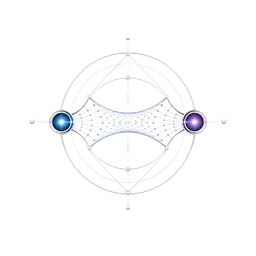
Adjacency Theory is a computational research programme asking whether the separation we experience as space is a derived property of a deeper relational structure — and what would have to be true before that structure could ever be called controllable.
Quantum-gravity bridge · latest verified push
Relations now generate the incidence and cell operators. Under edge locality, edgewise positivity, and endpoint-shift symmetry, the scalar action is forced to be the weighted Dirichlet form, whose Hessian is the Hodge Laplacian. Combined with the matter-viability audit, this leaves exactly one integer candidate dimension: three.
Separability
d > 2
Stable bound orbit
d < 4
Integer intersection
d = 3
Research update · QG-1B → QG-1E
Four linked results move the program from hand-picked geometry toward a relation-derived operator. The current wall is QG-2: derive time and a causal cone without relabeling Euclidean simulation steps as physical time.
QG-1B
PASSCommuting generator sets produce a complete cubical Hodge complex.
QG-1C
PASSCell, growth, and spectral dimension are now kept strictly separate.
QG-1D
CONDITIONALA target-free viability window gives 2 < d < 4, selecting integer d = 3.
QG-1E
CONDITIONALEdge locality, edgewise positivity, and endpoint-shift symmetry force the scalar Hodge Laplacian.
Breakthrough boundary
This is a mathematical reduction of assumptions—not evidence of a portal, jump drive, modified relativity, or physical transport. Those claims remain locked until a causal model and independent physical measurement exist.
The conceptual progression
Don't cross the distance
change it.
Separation becomes a variable rather than a given.
Don't change distance
change adjacency.
Distance is downstream. Adjacency is the structure that produces it.
Don't move the object
change its relational address.
R_X = (r_X1 … r_XN). The object stays; its relations do not.
Don't ask how something moves
ask what makes one state allowed to become another.
The transition operator T(R_i, R_j) replaces the trajectory.
Don't ask which mechanism works
ask what forbids every mechanism at once.
A fixed, tame map from the deeper layer bounds what any mechanism written on top of it can do. Find the wall first.
“Nothing is possible unless we have thought it.”
every model on this site · physicalClaim = false
Research thesis
The initial programme does not assume that a relational structure can be engineered. It asks what mathematical, causal and energetic conditions would have to hold before that claim could even become meaningful.
The core analogy
We assumed reaching page 1,000 requires crossing pages 2 – 999.
Adjacency Theory asks what determines which pages are next to each other.
Current frontier · AT-0766 → AT-0770
AT-0766
Paper screen only. ADG901 and SMV1275 retained for evaluation; nothing purchased.
AT-0767
Q1–Q3 protocol frozen: 2,400 planned complex sweeps and a measured 90 dB system-floor requirement.
AT-0768
Synthetic dry run rejects 11 injected failures, seals records, and forbids simulation from becoming physical evidence.
AT-0769
All 17 disconnect, replay, stale-data, identity-collision, and provenance attacks are rejected.
AT-0770
Concept architecture for an uncrewed orbital metrology laboratory—not a flight vehicle or transport claim.

AX-1 · Work in progress · Concept architecture
The copper-toned central ring houses the shielded experiment. Four serviceable petals separate power, control, witness, and thermal systems. Conventional thrusters, solar arrays, radiators, and communications remain visible because no adjacency propulsion effect has been demonstrated.
Stage gates
AT-0
Reproduction
Validate implementation before novelty.
AT-1
Perturbation
Measure ΔD in response to controlled ΔR.
AT-2
Transition
Search for nonlinear adjacency regimes.
AT-3
Reconstruction
Do relational states rebuild geometry?
AT-4
Causal geometry
Time, light cones, signalling limits.
AT-5
Energy
Stress-energy and energy-condition implications.
AT-6
Prediction
An observable that distinguishes the idea.
AT-X
Experiment
Only if every previous gate survives.
Scientific integrity gate
The success criterion for this project is not prove the theory. It is: make the theory precise enough that mathematics and experiment can prove parts of it wrong.